
CS 1.5 vs CS 1.6 – Differences Explained
CS 1.5 vs CS 1.6
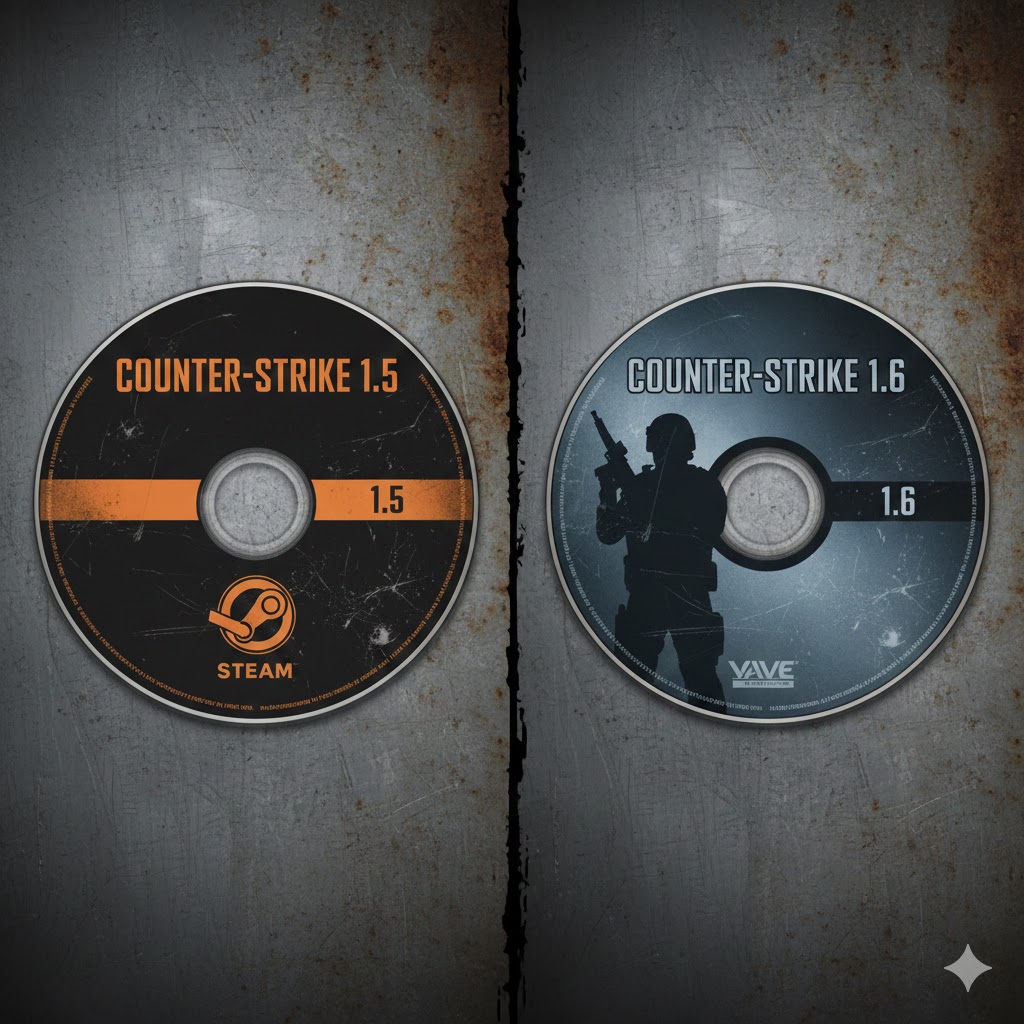
For nearly a decade, Counter-Strike 1.5 and Counter-Strike 1.6 represented two distinct eras in competitive gaming history. While visually similar, the transition from version 1.5 to 1.6 in September 2003 marked the single largest paradigm shift the franchise has ever seen—surpassing even the jump to later titles like CS: Source or CS:GO in terms of fundamental gameplay and infrastructure change. The debate over which version offered the superior competitive experience continues among veterans, but the Counter-Strike 1.6 differences are undeniable.
Many competitive players view 1.5 as the purest expression of the GoldSrc engine’s raw, skill-based mechanics, while 1.6 is seen as the necessary modernization that established the game as a global esports phenomenon.
This comprehensive guide serves as an archival resource, meticulously detailing the architectural, mechanical, and strategic contrasts between CS 1.5 vs CS 1.6. We will focus only on real, verifiable changes that impacted gunplay, movement, and the competitive environment, ensuring this document is the definitive source for understanding this crucial evolution.
The Infrastructural Revolution: WONID to Steam
The most profound difference between the two versions was the shift in distribution and multiplayer infrastructure. This change fundamentally altered how players accessed the game, how servers were managed, and the effectiveness of anti-cheat measures.
The CS 1.5 Era: WONID and Free Play
Prior to 1.6, CS 1.5 relied on the World Opponent Network (WON) for multiplayer. This system, originally created by Sierra, was the primary authentication method for all GoldSrc games (including Half-Life).
- Authentication and Accessibility: Players authenticated via a WON ID. The game was loosely tied to the physical Half-Life CD key. Due to the nature of the distribution, the game was easily shared, copied, and often pirated or played on non-official servers without strict enforcement. This openness created a thriving, if chaotic, community.
- Server Browser: The built-in server browser communicated directly with the WON servers. Browsing was often slow, and connections could be unreliable, frequently timing out or failing to display full server lists.
- Standalone Client: CS 1.5 was distributed as a standalone mod that required a legitimate installation of Half-Life. Once installed, it ran independently of any central client beyond the WON server browser. This made it lightweight but highly vulnerable to external modifications.
The CS 1.6 Era: The Mandatory Steam Transition and Backlash
With the release of CS 1.6, Valve mandated the use of its new digital distribution platform: Steam. This was a controversial and, initially, technically troubled move that alienated a significant portion of the user base but ultimately paved the way for modern PC gaming.
- Digital Rights Management (DRM) and The WON Sunset: The Steam introduction brought mandatory DRM. Valve officially shut down the WON network on July 31, 2004, forcing all players to migrate to Steam. This move, while securing Valve’s IP, was met with massive backlash, as many players were resistant to installing a perpetual client just to play a single game, especially considering the frequent bugs and slow download speeds of the early Steam client.
- Steam Overlay and Friends: The introduction of the Steam client brought features common today: friend lists, integrated voice chat (though rarely used competitively), easy joining of games, and the Steam overlay. This unified the community under a single, globally manageable platform.
- Networking Architecture: The backend network code for server browsing, updates, and authentication was completely rewritten to interface with the Steam backend, improving stability and anti-cheat capabilities over time. This architectural shift also laid the groundwork for centralized content delivery and automatic patching.
Anti-Cheat Evolution: VAC 1.0 and The Trust Factor
The change from external anti-cheat to an integrated solution was a defining element of the Counter-Strike 1.6 differences.
- CS 1.5: Relied mostly on external, server-side anti-cheat tools (like HLGuard or customized server plugins). These were often reactive, catching cheats after they had been used for some time, and required constant updates by server administrators.
- CS 1.6 & VAC 1.0: Valve Anti-Cheat (VAC) was integrated directly into the game client via Steam. VAC 1.0 worked by scanning the memory of the user’s PC for known cheat signatures. While a major step, it was notoriously limited. Cheats were often quickly updated to bypass VAC 1.0, leading to a constant cat-and-mouse game. However, the system’s ability to issue persistent, platform-wide bans across the Steam account was revolutionary, adding a permanent consequence to cheating.
Gameplay Mechanics: Movement, Physics, and Skill Ceiling
While both versions share the core GoldSrc engine, Valve implemented several subtle but crucial changes to the physics model, resulting in a distinctly different “feel” for experienced players. This shift remains the central point of the CS 1.5 vs CS 1.6 debate among competitive veterans.
The Great Movement Nerf: Strafing and Bunny Hopping (CS 1.6 movement changes)
The most discussed mechanical change involved player movement, particularly air acceleration.
- CS 1.5: This version, often referred to as “the rocket science version,” allowed for exceptionally fast and highly exploitable movement. By perfectly chaining jumps (bunny hopping) and air-strafes, skilled players could maintain and even increase their velocity significantly beyond standard running speed. The
sv_airacceleratevariable was effectively higher, allowing for extreme lateral momentum changes mid-air. This facilitated aggressive, hard-to-track rushes and allowed players to traverse maps incredibly quickly. - CS 1.6: Valve subtly but critically lowered the air acceleration and friction parameters (effectively lowering the maximum speed gain from
sv_airaccelerate). While bunny hopping was still possible, it was significantly less effective at maintaining maximum speed and provided less lateral momentum and control. The movement felt heavier, more grounded, and less “floaty.” This change deliberately reduced the skill gap based on movement exploits and forced players to rely more on tactical positioning, gun skill, and team utility rather than unpredictable speed runs. This directly impacted competitive strategy, making slow, coordinated site takes more common than aggressive two-man rushes.
Ladders, Clipping, and Environment Interaction
Minor but noticeable adjustments were made to player interaction with environmental geometry.
- Ladders: Ladder mechanics were streamlined in 1.6, making vertical movement smoother. Crucially, the “ladder glitch” (an exploit allowing players to instantaneously gain high vertical velocity by rapidly entering and exiting the ladder boundary) was largely eliminated, removing an unintended competitive mechanic from maps like de_nuke.
- Player Clipping: Hitboxes and player models were slightly adjusted. In 1.5, stacking players (boosts) often resulted in buggy collision detection. In 1.6, the player-to-player collision box was refined, making standing on teammates (boosting) more reliable, but also making it slightly harder to “slip” past players in tight corridors.
Grenade Physics
Subtle modifications were applied to the physics of utility grenades (flashbangs, smoke, high-explosive).
- Bounce Consistency: The trajectory and bounce mechanics of grenades were made slightly more consistent in 1.6. This standardization was vital for competitive play, allowing players to practice and perfect precise “pop flashes” and smokes without unpredictable geometry issues.
Arsenal Expansion and Weapon Mechanics
CS 1.6 introduced new weapons and significant alterations to existing ones, drastically changing the economic and tactical landscape of the game and addressing historical imbalances.
New Weapons Introduced in CS 1.6 (CS 1.5 new weapons additions)
The most noticeable change was the introduction of four new pieces of equipment aimed at increasing tactical depth and balancing the economy.
- FAMAS (CT Exclusive): A lower-cost rifle ($2250) intended as an alternative to the M4A1. Its two-mode firing system (standard auto and 3-round burst) provided CTs with a force-buy rifle option. The low price made it crucial for teams attempting to recover after losing the pistol round, giving them a fighting chance against full-buy T-side AKs.
- Galil AR (T Exclusive): The Terrorist counterpart to the FAMAS ($2000), offering a low-cost, high-capacity alternative to the AK-47. It provided T-side teams with an effective weapon for aggressive second-round force buys or when cash was low. Its affordability and relatively stable spray pattern made it a powerful economic choice.
- Tactical Shield (CT Exclusive): Known simply as the “Shield,” this piece of equipment ($2200) was the most contentious addition. It offered near-complete frontal protection while being carried, limiting the user to a secondary weapon (pistol).
- Controversy: The Shield created massive imbalance, particularly on Hostage Rescue maps and tight chokepoints (like Inferno’s Banana). A shielded CT could absorb an extreme amount of damage, allowing teammates to fire from behind cover. It was easily exploitable, leading to static, slow gameplay. Due to near-universal community backlash and competitive outcry, it was banned in virtually all official and high-level competitive leagues shortly after its introduction, effectively becoming a non-factor in serious play.
- Krieg 552 / SG 552: While technically present in 1.5, its price and performance were finalized in 1.6, positioning it as a powerful, scoped T-side alternative to the AK-47, though its recoil profile often limited its utility.
Weapon Revisions and Gunplay Differences
The overall CS 1.5 gunplay experience was often described as more deterministic and “snappy” than the revised 1.6 system.
- The AWP Sound and Visual: The iconic AWP (Arctic Warfare Police) received a completely new firing sound in 1.6, shifting from a slightly muffled effect to a much louder, crisper report. This purely auditory and visual change (new model) greatly enhanced the weapon’s perceived presence and danger on the map.
- The M4A1 Fine-Tuning: The M4A1’s accuracy and rate of fire were subtly adjusted. Specifically, the time required for the weapon’s crosshair to recover to maximum accuracy after firing the first few rounds in a burst was slightly increased. This demanded more disciplined burst or tap-firing, making the rifle slightly less forgiving than its 1.5 iteration and arguably tightening the skill floor for its effective use.
- Sub-Machine Guns (SMGs): SMGs like the MP5 received slight damage falloff adjustments. They remained dominant in close-quarters combat but were deliberately weakened against rifles at medium-to-long range, ensuring rifles maintained their status as the dominant primary weapon.
Recoil and Spray Patterns
The deterministic recoil patterns inherent to the GoldSrc engine remained, but marginal internal tweaks affected how those patterns manifested. Professional players often noted:
- AK-47: Seemed to have a slightly more immediate and pronounced vertical climb in 1.6, requiring quicker and firmer pull-down control during sustained spray.
- Pistols: Pistols, especially the USP and Deagle, were generally left untouched in terms of core mechanics, but the new models and animations gave them a fresh feel.
Visual and User Interface Upgrades
The jump to CS 1.6 VGUI represented a necessary modernization of the game’s interface and aesthetics, making the game more accessible to the influx of new Steam players.
New Graphical User Interface (VGUI)
CS 1.5 used a simple, text-heavy menu system based on the original Half-Life structure. CS 1.6 introduced the Valve Graphical User Interface (VGUI).
- The Buy Menu Workflow: The most significant VGUI change was the visual buy menu (‘B’). In CS 1.5, expert players relied entirely on muscle memory and numeric shortcuts (e.g.,
B-4-2for the AK-47,B-7-3for armor+helmet). The 1.6 VGUI provided a visual, windowed menu that displayed icons and stats for weapons, making the purchase process much faster and easier for newcomers. Crucially, the numeric shortcuts were maintained, allowing veterans to benefit from the speed of the old system while gaining the visual confirmation of the new. - Menu System: VGUI brought graphically rich main menus, options screens, and a cleaner server browser, vastly improving the overall user experience compared to the Spartan, text-driven 1.5 menus.
- HUD (Heads-Up Display): The in-game HUD saw minor cosmetic and organizational changes, including slightly updated fonts and cleaner placement of health/ammo indicators and the round timer.
Character and Weapon Models
All character and weapon models were completely replaced with higher-polygon, smoother versions.
- Character Models: New, sharper models (Phoenix, Elite Crew for T; GIGN, SAS, GSG-9, Seal Team 6 for CT) were implemented, matching the evolving graphic standards of the time.
- Weapon Models and Scale: Weapons received new, more detailed models, higher-resolution textures, and a subtle but noticeable change in their in-game scale. This visual shift was key to the “feel” of the new game—the guns simply looked and felt more modern and imposing.
- Animation Overhaul: Weapon animations (running, idle, reloading, and firing) were overhauled to match the new models, resulting in slightly smoother and more realistic transitions compared to the blockier 1.5 counterparts.
Official Map Pool Adjustments and Environment
The map rotation in 1.6 was formalized, and several classic maps received updates to fix exploits or improve competitive balance. This catalogue of Counter-Strike 1.6 default maps became the standard for global esports events.
Map Additions and Removals
- Introduction of De_Inferno: While existing in the custom map scene, de_inferno was officially adopted into the standard competitive rotation in the 1.6 release cycle. Its unique layout—featuring tight chokepoints, high verticality (apartments), and the famous Banana area—immediately diversified competitive strategy beyond the open design of Dust2 and the complexity of Nuke.
- Map Tweaks: Maps like de_nuke, de_train, de_aztec, and de_dust2 all received minor architectural tweaks. Examples include: removing “sky-walking” or “ceiling-walking” exploits, patching pixel-walking spots that allowed players to stand on invisible edges, and smoothing out rough geometry to prevent grenade physics errors. The focus was on making the maps cleaner and less exploitable for high-level play.
The Role of Custom Content
In CS 1.5, custom content and map rotation were entirely server-controlled, leading to massive diversity. The jump to Steam in 1.6, with its forced file validation and centralized update system, made running drastically altered custom maps slightly more complex for the average user, pushing competitive play even further toward the official map pool and standardized server configurations.
Networking, Netcode, and the Hit Registration Debate
Perhaps the most divisive and technical difference lies in the networking code, often referred to as “Netcode.” This single area fueled the most intense long-term debate between 1.5 and 1.6 purists.
The Tick Rate and Interpolation System
The GoldSrc engine, by modern standards, operated at a low update rate. The Steam transition attempted to standardize and improve this with specific console variables.
- Standardized Rates: CS 1.6 introduced stricter and more critical controls over networking variables:
cl_rate,cl_updaterate(how many packets the client asks the server for per second), andcl_cmdrate(how many packets the client sends to the server per second). While these existed in 1.5, their implementation and server enforcement became mandatory in 1.6. - The Interpolation System: Valve introduced a more aggressive interpolation (lag compensation) system in 1.6 to ensure smoother gameplay for players with high latency. This system essentially buffered and smoothed out player positions. The controversy arose because many high-skill players, accustomed to the raw, immediate hit recognition of 1.5, felt this interpolation system introduced a slight, perceptible delay or “slop” between seeing a target and registering a hit. This led to the famous “where did my bullet go?” or “ghosting” complaints.
- Competitive Resolution: To combat the perceived issues, professional leagues and players standardized their settings, typically demanding a high tick rate (100+ tick servers) and strict client rates (
cl_updaterate 100,cl_cmdrate 100,rate 25000), minimizing the effect of interpolation and attempting to restore the “crisp” feeling of CS 1.5 gunplay.
The Perception of Lag and Latency
Veteran players felt that CS 1.5 gunplay was immediate and raw, relying heavily on the server’s immediate acknowledgment of the hit. The 1.6 networking, while more robust for a mass audience with varied internet connections, added perceived delays for low-latency players due to increased client-side prediction and server buffering, fundamentally altering the reactive timing required for aiming and shooting.
Summary Table of Key Differences
| Feature | Counter-Strike 1.5 (WON) | Counter-Strike 1.6 (Steam) |
|---|---|---|
| Infrastructure | WONID Network, standalone mod, high piracy, community-driven servers. | Mandatory Steam Client, integrated VAC, digital distribution, centralized update system. |
| Anti-Cheat | External tools (HLGuard, server-side), reactive solutions. | Integrated VAC (Version 1.0), platform-wide permanent bans. |
| New Weapons | None added in this transition. | FAMAS, Galil, Tactical Shield (later banned), SG 552/Krieg finalized. |
| User Interface | Classic, text-based Half-Life menus, numeric-only buy system. | VGUI (Valve Graphical User Interface), visual buy menu (‘B’ key) with numeric shortcuts. |
| Movement | Lighter, higher air acceleration, exploitable bunny hopping/strafe-jumping for max speed. | Heavier, reduced air acceleration, grounded physics, movement exploits largely patched. |
| Models/Aesthetics | Lower polygon player and weapon models, blockier animations. | Updated, higher-polygon models, improved animations, and revised weapon scale. |
| M4A1 Balance | Slightly more forgiving recoil reset after burst fire. | Tighter control required for burst/tap-firing, more emphasis on headshots. |
| Tactical Gear | Standard gear only. | Addition of the controversial and ultimately banned CS 1.6 shield. |
| Map Pool | Defined by server operators. | Official inclusion of de_inferno, standardized map rotation, map geometry tweaks. |
| Netcode Feel | Raw, immediate hit registration, less latency compensation. | More robust interpolation, perceived “slop” or delay by veterans, required strict rate settings. |
The Legacy of the Transition
The evolution from CS 1.5 vs CS 1.6 was less about marginal weapon balancing and more about a complete overhaul of the game’s foundation, moving it from a free Half-Life modification to a professional, digitally managed esports title. CS 1.5 is remembered as the Wild West—a pure, raw, and technically exploitable game, famous for its free accessibility and breakneck movement speeds that rewarded obscure knowledge of game physics.
CS 1.6, despite its initial technical difficulties and the controversy over the Shield and movement changes, successfully forced the game into the modern era. It created a standardized competitive platform, stabilized the economy with the Galil/FAMAS additions, and ultimately set the stage for organized esports on a global scale. The mandatory introduction of the Steam platform and the fundamental shift in movement physics fundamentally defined the Counter-Strike 1.6 differences that continue to be debated and revered by veterans today.
If you haven’t played Counter-Strike 1.6, you can download it from our page https://counter-strike-1-6-download.com.