
Counter-Strike 1.6 vs Counter-Strike Source: GoldSrc to Source
Counter-Strike 1.6 vs Counter-Strike Source
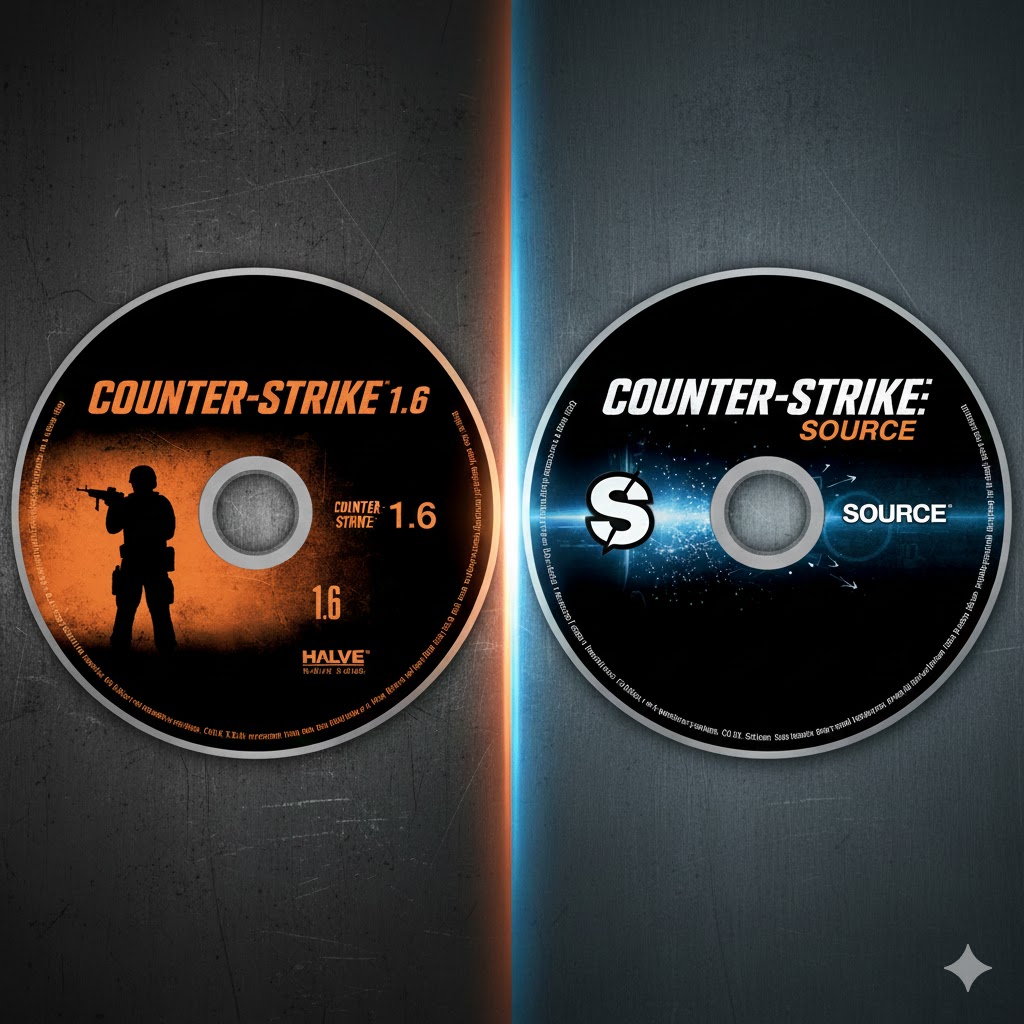
The year 2004 marked a pivotal and divisive moment in the history of competitive gaming with the release of Counter-Strike: Source (CSS), bundled as part of Valve’s landmark The Orange Box collection. Until this point, Counter-Strike 1.6 (CS 1.6), running on the venerable GoldSrc engine, had reigned supreme, defining the competitive FPS genre with its raw, almost archaic, yet universally respected mechanics.
The core question of Counter-Strike 1.6 vs Counter-Strike Source became the gaming community’s most intense debate, pitting the perfection of an old, raw skill-based system against the promise of modern technology.
This split—often referred to as “The Great Divide”—was not merely about graphics; it was a fundamental shift in game design philosophy. CS 1.6 operated on the principle of absolute, deterministic player control, rooted in the legacy of the Quake engine. CSS, on the other hand, was the showcase for Valve’s powerful, modular Source Engine Physics, introducing realism, environmental interactivity, and advanced visual fidelity powered by the Havok physics engine.
The core philosophical question was whether the unpredictable dynamics of realism enhanced or undermined the pure competitive integrity that had made CS 1.6 a global phenomenon.
This comprehensive analysis will delve into the profound technical and competitive differences that separated these two titans, spanning the engine architecture, core mechanics, gunplay, networking, and the subjective feel of movement, thereby fully explaining the CS 1.6 vs CS: Source dichotomy and its long-term impact on the franchise’s evolution.
Engine Architecture and Physics Core: GoldSrc vs. Source 1
The foundation of the two games lay in engines separated by nearly a decade of technological advancement. The shift from the Quake-derived GoldSrc to the Source 1 Engine (Source) was the single most impactful factor in defining the games’ divergent mechanical feel.
GoldSrc Engine: The Quake Legacy and Mechanical Purity
The GoldSrc engine was a heavily modified version of the QuakeWorld engine. Its architecture was simple, highly optimized for single-core CPUs of the late 90s, and inherently deterministic.
- Simplicity and Determinism: GoldSrc’s simplicity meant that player inputs and game state updates were processed with predictable regularity. The physics model was linear, basic, and crucially, fully understood and exploitable by the community. There were no complex object interactions; the world was static save for player models and projectiles.
- The GoldSrc Advantage: The lack of modern physics overhead meant that the game could focus almost exclusively on processing rapid player inputs and network packets efficiently. This fostered a community reliant on muscle memory for complex mechanical exploits. The engine was built for speed and responsiveness above all else.
- Visual Limitations: GoldSrc maps relied on “baked” lighting, where shadows and light sources were static and pre-calculated during the map compiling process. Textures were low-resolution, and geometry was basic (brush-based), which, while visually primitive, contributed to maximum competitive clarity.
Source Engine (Source 1): Realism and the Source Engine Physics
The Source Engine was a complete rewrite, developed by Valve to be modular and highly scalable. Its main selling point was the integration of the Havok physics engine.
- Integrated Havok Physics: This was the game-changer. CSS maps were filled with complex, movable debris (crates, barrels, signposts), glass, and dynamic obstacles. Grenades could push physics objects, and environmental damage was possible. However, the integration of Source Engine Physics also introduced complexities. Interactions became unpredictable—a core competitive negative for many 1.6 veterans.
- Hardware Demands: Source 1 was demanding for the time, supporting multi-core processing and advanced rendering features like High Dynamic Range (HDR) and bloom. This meant higher visual fidelity but alienated many players running older hardware, a community that had thrived on 1.6’s low barrier to entry.
- Aesthetic Shift: The move to dynamic lighting and detailed textures provided graphical realism, but the abundance of visual effects and geometry often compromised the clean sightlines CS veterans relied on. This contrast forms the heart of the GoldSrc vs Source Engine debate and fundamentally separates the gameplay experience of Counter-Strike 1.6 vs Counter-Strike Source.
The Subjective Experience: CS 1.6 Movement vs. CS: Source Movement
The “feel” of movement is the single most cited difference when comparing the two games. It defined the high-skill ceiling of 1.6 and the divisive nature of Source.
The Mastery of CS 1.6 Movement
In 1.6, movement was an art form. It was governed by specific acceleration and air control constants within GoldSrc:
- Bunny Hopping (BHop): This was a fundamental high-level skill. Through precise timing of jumps and air strafing (
AandDkeys), players could chain jumps together to exceed the standard running speed. This exploit was essential for fast rotations, early map control, and evasion, and was a testament to the game’s deterministic physics. - Silent Running (
slow_walk): A crucial mechanic performed by binding a key to a specific console command (+duck; +walk). This allowed for completely silent movement, critical for stealth and positioning. - Air Control: The ability to dramatically change momentum in the air (air strafing) made jump-scouting and utility throws highly skill-dependent but predictable. CS 1.6 Movement rewarded dedication to mechanical exploits.
The Realism of CS: Source Movement
The CS: Source Movement was fundamentally altered by the Source 1 engine’s implementation of Havok and more realistic friction/gravity.
- “Floaty” Physics: To accommodate the new physical realism, player models felt “heavier” and “floaty.” Acceleration and deceleration were smoother, but momentum control was vastly reduced compared to 1.6. This made quick, aggressive peeking feel less snappy.
- BHop Reduction: Bunny hopping was severely restricted. While still possible, it offered minimal speed gains and required far stricter precision, effectively removing it as a core competitive mechanic.
- Removal of Silent Run: The
slow_walkcommand was removed in favour of standard walk/crouch sounds, drastically simplifying the stealth aspect and reducing the information warfare inherent in 1.6. - Competitive Impact: This shift was polarizing. Veterans felt the removal of these high-skill movement mechanics lowered the skill ceiling, making movement less of an offensive and defensive tool. Newcomers found the movement more intuitive and realistic. This dichotomy is central to understanding the split between Counter-Strike 1.6 vs Counter-Strike Source.
Gunplay, Recoil Patterns, and the Shift in Spray Control
The methodology for weapon control saw a profound change that defined which playstyles were viable in each game.
CS 1.6 Gunplay: Fixed and Repeatable Recoil
CS 1.6 demanded absolute consistency from its players because its recoil was a known, fixed pattern.
- Deterministic Recoil: The spray pattern of the AK-47, M4A1, and other weapons was constant. A player could train to counter the vertical and horizontal deviation perfectly through muscle memory alone. The skill lay in executing the counter-pattern flawlessly, regardless of external factors.
- First Shot Accuracy: Crucially, the first bullet was near-perfectly accurate, making the Recoil Differences less about randomness and more about mechanical precision.
- The AWP: The AWP was arguably more potent in 1.6 due to the movement speed after a quick-switch, a mechanic that was nerfed in Source.
CS: Source Gunplay: Increased Randomness
The Source Engine introduced more variability into the firing mechanics.
- Randomized Spray: While a base recoil pattern existed, Source incorporated significantly more horizontal randomization, particularly after the first few bullets. This meant that even a perfectly executed mouse movement would not guarantee the same outcome, introducing an element of variance.
- Focus on Bursting: The greater randomization meant that full-auto spraying beyond short distances was highly discouraged. Players were forced to rely more heavily on 2–3 bullet controlled bursts or single taps, shifting the emphasis from deterministic pattern control to generalized aim and reset time. This created clear Recoil Differences that affected the subjective feel of CS 1.6 Movement and gunplay.
- Visual Kickback: CSS introduced more pronounced weapon visual kickback and screen shake, slightly obscuring the player’s view during sustained fire, which was minimal in 1.6.
Hitboxes, Networking Consistency, and the Tick Rate Illusion
Networking performance and the accuracy of hit registration were major sources of contention, especially during the early years of CSS.
CS 1.6 Hitboxes and Consistency
CS 1.6 utilized a simpler, polygon-based hitbox system.
- Box Model: Hitboxes were generally larger, simpler geometric shapes (capsules or large boxes) wrapped around the major body parts (head, torso, limbs). While crude by modern standards, they were highly consistent, ensuring that if your crosshair was precisely on the enemy model, the hit registered reliably. This consistency was paramount to competitive integrity.
- Netcode: While limited by the fixed tick-rate (66-100Hz), 1.6’s networking model, coupled with simpler physics calculations, provided a “raw” feel where high ping was severely penalized, but low-ping execution felt immediate.
CS: Source Hitboxes and Inconsistencies
CSS attempted to introduce a more realistic per-bone hitbox model.
- Per-Bone Complexity: The shift to per-bone hitboxes meant that the hit registration was tied to the animated skeletal structure of the player model. In early Source 1 versions, the implementation was buggy. Players reported Hitbox Differences where bullets registered hits on empty space next to the model, especially during movement or animation transitions. This created a sense of unreliability and frustration, significantly compromising the competitive environment.
- Networking Issues (Early): Despite running on the same general tick rates, early CSS netcode was often criticized for poor interpolation and inconsistent registration, especially when compared to the reliable GoldSrc environment. These issues, combined with the buggy hitboxes, were a major factor in the community’s resistance to the new game and heavily influenced the perception of Counter-Strike 1.6 vs Counter-Strike Source hit registration reliability.
Visuals, Readability, and the Bloom and HDR Effect
The graphical leap in CSS was undeniable, but its aesthetic choices often clashed with competitive needs.
- Fidelity vs. Clarity: CS 1.6’s low-fidelity graphics were a competitive strength. The static, high-contrast environments ensured maximum player readability—enemies stood out clearly against backgrounds.
- The Source Visuals: CSS introduced dynamic shadows, higher poly models, and detailed textures. However, the introduction of Bloom and HDR lighting effects severely complicated visibility. Bright areas (like sunny map entrances) would wash out shadows, and players moving between dynamically lit areas could momentarily become camouflaged or obscured by glare. The introduction of Bloom and HDR lighting effects severely complicated visibility, contrasting starkly with the competitive clarity prioritized in CS 1.6 vs CS: Source.
- Visual Clutter: The increase in environmental detail—foliage, physics debris, texture noise—created more visual clutter, which often interfered with the crucial milliseconds required to identify and acquire a target, a problem absent in the clean slate of 1.6. This was often perceived as lowering the skill gap by introducing unnecessary visual interference.
Utility and Map Design: Subtle but Strategic Shifts
While the core utility items (Flash, HE, Smoke) remained, their interaction with the new physics engine changed strategic dynamics.
- Grenade Physics: In 1.6, grenade throws were deterministic and often tied to exact jump timings (jump-throws were crucial for precise smoke placement). In CSS, Havok physics meant grenades had realistic bounce and momentum, making throws more visually realistic but less precise for competitive lineups.
- The Smoke Factor: Both CS 1.6 and CS: Source smokes were static, cylindrical barriers (unlike CS2’s volumetric smokes). However, the increased geometric complexity of Source maps made establishing effective, seamless smoke walls more challenging.
- Map Redesigns: The redesign of classic maps was highly controversial. While Valve aimed for realism, changes to sightlines, clip brushes, and cover geometry fundamentally altered established strategies.
- De_Dust2: Received smoother geometry, but key angles felt different.
- De_Nuke: The verticality and bomb site layout were significantly altered, forcing players to relearn timing and sightlines.
- Environmental Interaction: The dynamic physics introduced new, minor tactical elements, such as being able to shoot and destroy glass or break down wooden doors, offering novel but minor approaches to certain bomb sites.
Competitive Ecosystem and Community Divide
The release of CSS fractured the existing competitive infrastructure, forcing leagues and teams to choose sides.
- The 1.6 Holdouts: Many established teams, especially in Europe (ESL) and North America (CPL, CAL), initially resisted the transition. They argued that CSS was fundamentally flawed due to the movement and hitbox issues. They stuck with CS 1.6, ensuring its competitive life extended for many more years. Major tournaments continued to feature 1.6.
- The CSS Pioneer Leagues: Younger leagues and a new generation of players embraced CSS. The game’s superior graphics and connection to the modern Steam platform made it more appealing to mass audiences. Leagues like the ESEA (in North America) and sections of ESL (in Europe) became the competitive homes for CSS. The competitive landscape during the peak of Counter-Strike 1.6 vs Counter-Strike Source was fractured, forcing leagues to decide between the stability of the GoldSrc engine and the future promised by the Source Engine.
- External Anti-Cheat: Both games relied on external systems for competitive integrity. While 1.6 was protected by early VAC and external tools like HLGuard, CSS benefited from the development of more robust client-side anti-cheat tools like the ESEA client and later versions of the built-in VAC system, which was necessary to counter the more complex cheating tools of the Source era.
- Economy: The core economy of both games remained functionally identical (money earned for kills, losses, wins, and bomb plants). The only subtle change was the addition of more complex weapon skins and cosmetic items in CSS that were absent in the purist 1.6 client.
The Legacy of the First Split: Paving the Way for CS:GO
The enduring CS 1.6 vs CS: Source debate ultimately served as a vital design crucible for Valve. The lessons learned from the community’s strong reaction defined the creation of the next iteration, Counter-Strike: Global Offensive (CS:GO).
- The GoldSrc Lesson: Valve learned that competitive integrity requires deterministic, predictable mechanics. The community valued consistency over physical realism.
- The Source Lesson: The Source Engine provided the necessary platform for modern graphics, better networking, and integration with the global Steam ecosystem. The failure points (floaty movement, random recoil, inconsistent hitboxes) were clearly identified.
- CS:GO as a Synthesis: CS:GO, built on an updated Source Engine branch, sought to synthesize the best of both worlds. It brought back the deterministic elements of CS 1.6 Movement (better air control, less “floaty” feel), while retaining the modern graphics and utility expansion (Molotovs/Incendiaries) introduced in CSS. It introduced more complex but still fully deterministic recoil patterns, bridging the gap between the two philosophies.
The decision to migrate from GoldSrc vs Source Engine was necessary for the franchise’s survival, and the enduring debate of Counter-Strike 1.6 vs Counter-Strike Source provided invaluable lessons for modern competitive FPS design. CS 1.6 remains a benchmark for raw competitive skill, defined by its simplicity and mechanical exploits. CS: Source, despite its flaws, was the necessary evolutionary step that introduced the game to a modern engine, setting the stage for the global esports success of its successor.
Try the Divide for Yourself
If you are interested in experiencing these legendary differences firsthand, you can try downloading Counter-Strike 1.6 from our site at https://counter-strike-1-6-download.com.
To try Counter-Strike: Source (CSS), you can acquire it directly from the official Steam store: https://store.steampowered.com/app/240/CounterStrike_Source/.
Dive in and decide for yourself which version truly represents the pinnacle of competitive Counter-Strike!